Beyond the Emergency Department, Part 3: Building a Safe and Sustainable Right-Care System
A practical framework for connecting appropriate patients with community care, nurse navigation, telehealth, and alternative destinations while preserving dependable access to emergency care.

A patient agrees to receive care somewhere other than the emergency department. The ambulance leaves. A referral appears in the electronic record.
What happens next?
That is the question on which an alternative-care program should be judged. Someone must accept the patient, deliver the agreed service, recognize when the plan is failing, and help the patient obtain further care. Until those responsibilities are clear, the system has arranged a different disposition without necessarily solving the healthcare need.
Part 1 examined why the ED remains the default destination and how community paramedicine, nurse navigation, and telehealth can create additional options. Part 2 explored international approaches and the conditions that determine whether they can work elsewhere.
This final installment turns those lessons into an implementation framework. Its recommendations and example measures are a starting point for local design, not a validated clinical protocol or a universal performance standard.
The objective is a dependable care pathway that patients and clinicians can trust, including a clear route to emergency evaluation whenever it becomes necessary.
Begin with the care gap
The first planning meeting should establish whose needs are going unmet. An agency might identify patients struggling to obtain timely primary care, people needing coordinated follow-up after hospital discharge, or residents whose recurring calls reflect unresolved medical and social needs. Each group may require a different service.
Review local call patterns, patient records, receiving-facility information, and community-service capacity. Include frontline clinicians and patients in that review. A retrospective diagnosis can help describe utilization, but it does not tell a crew what was safely knowable before the patient was assessed. Likewise, repeated 911 use is a reason to investigate unmet need; it is not an eligibility rule for avoiding the ED.
The NAEMSP position statement on mobile integrated health care and community paramedicine emphasizes community needs assessment, physician medical direction, collaboration, and sustainable reimbursement. It also supports education and competency evaluation suited to the services being delivered. NAEMSP position statement
Translate the identified gap into a specific aim. For example: improve timely access to an accepting community clinician for patients who meet a defined pathway's criteria, while monitoring subsequent urgent care and referral completion. This is more actionable than a promise to reduce transports across the entire service area.
Begin with one population and a receiving service capable of meeting its needs. A broad menu can come later, when the organization has shown that a narrower pathway works reliably.
Put responsibility in writing
An alternative-care program needs clinical and operational owners before it needs a launch announcement. Establish a governance group that includes the EMS medical director, operational leadership, dispatch, field clinicians, navigation or telehealth partners, receiving services, quality personnel, and patient or community representation. Bring finance, privacy, and regulatory expertise into decisions that require them.
The group should agree who approves eligibility criteria, who provides consultation, who can change the care plan, and who investigates a missed appointment or delayed escalation. It should also identify who can suspend a pathway when staffing, clinical support, or receiving capacity becomes inadequate.
Map responsibility across each transition. Who is responsible while the patient waits for a remote clinician? When can a field crew leave? Who monitors the patient until a home visit occurs? Who acts if the next service never arrives?
These arrangements require local authorization and agreement across organizations. A physician's involvement does not, by itself, establish every necessary scope-of-practice permission, destination approval, data-sharing arrangement, or payment entitlement. Address those requirements before enrollment begins.
Shared governance should make responsibility easier to identify. It should never make responsibility disappear.
Define suitability and protect patient choice
"Low acuity" describes a broad category. It does not establish that a particular patient can safely receive care at home, by telephone, or at a clinic.
Medical directors and partner clinicians should define the assessment required for each pathway, the population it covers, the circumstances that exclude its use, and the situations requiring consultation or emergency evaluation. A pathway should explicitly consider uncertainty, changing symptoms, abnormal findings, relevant medical history, decision-making capacity, safeguarding concerns, and whether the proposed service can meet the patient's actual needs.
Telephone navigation and a disposition after an in-person assessment require different safeguards. A dispatch classification should not substitute for the clinical assessment required by the pathway. Populations with additional assessment needs, such as children, pregnant patients, frail older adults, or people experiencing a behavioral-health crisis, need deliberately designed arrangements rather than automatic inclusion in a general pathway.
A useful implementation check has four parts: clinical suitability, informed agreement, receiving-service readiness, and a feasible follow-up plan. All four deserve explicit attention. This is a planning framework, not a clinical clearance checklist.
The conversation with the patient should explain the recommended option, why it may meet their needs, its limitations, expected timing, available alternatives, and any known costs. Give the patient an opportunity to ask questions and verify understanding. Record the decision without presenting acceptance as a test of cooperation.
Declining an alternative pathway should lead to continued assessment and an appropriate disposition under applicable protocols and patient rights. It should not automatically be recorded as refusal of all care. Avoid targets that reward clinicians for persuading patients to accept alternatives regardless of suitability.
Clinical concern or an unavailable service should trigger reassessment and a safe alternative plan. Emergency care must remain accessible whenever it is needed.

Build the receiving network and complete the handoff
A list of clinics is a directory. An operational network tells the crew which service can accept this patient, for this need, at this time.
Receiving-service agreements should address hours, available capabilities, eligibility, acceptance procedures, appointment timing, transport arrangements, information transfer, and what happens when capacity changes. They should specify how declined referrals, missed visits, and clinical deterioration are handled. The patient's journey home also matters when an alternative destination is involved.
NHS England's single point of access guidance provides a useful organizational example. It brings multidisciplinary advice and referral functions together and addresses receiving-service capacity, responsibility for ongoing care, and action on rejected referrals. The transferable lesson is to give clinicians a dependable way to arrange care across organizational boundaries. Its operating model still requires adaptation to local circumstances. NHS England guidance
For a local pilot, build a handoff that can be checked from beginning to end:
1. Confirm that the receiving service accepts the patient and the proposed timing.
2. Transfer the relevant clinical information and document who holds responsibility during the transition.
3. Confirm whether the patient actually received the service.
4. Act on a missed connection, deterioration, or other unresolved need.
Sending a referral is one event in that process. It is not proof of completed care. A successful software transaction can still leave a patient waiting by the telephone.
The team should define how soon each type of referral needs confirmation. An urgent same-day assessment and a planned preventive visit require different follow-up arrangements. When a service is unavailable, the plan must change; the patient should not inherit the task of finding a replacement alone.
Every referral needs an accepting service, a named owner, and a documented outcome.

Make telehealth part of the clinical workflow
Telehealth becomes useful when it helps the team make and carry out a care decision. Purchasing tablets is only a small part of that work.
Specify who answers consultations, which clinical information must be available, how interpretation is arranged, and how decisions enter the patient record. Agree how long a patient may appropriately wait for consultation and what happens when the clinician or connection is unavailable. These expectations should reflect clinical need and local capability, rather than an arbitrary universal time limit.
For remote encounters, build in confirmation of the patient's location and a reliable callback method. Plan for disconnection, deterioration, and conversion to an in-person assessment. A technical problem should activate a defined response, not extend an unsafe wait.
Give field clinicians, dispatchers, navigators, and remote practitioners joint practice with the process. Competency should include presenting an assessment, recognizing uncertainty, explaining choices, documenting responsibility, and arranging escalation. Test awkward scenarios: the clinic closes unexpectedly, the patient cannot hear the consultation, or the remote clinician recommends transport after an alternative was initially discussed.
Include paid training time, accessible clinical support, and feedback from actual cases. Staff should be able to raise concerns and change a disposition when the patient's needs warrant it.
Make the plan usable in the patient's life
An alternative pathway can be clinically reasonable and practically impossible. The patient may lack transportation, a working telephone, medication access, privacy, an interpreter, or a safe place to wait.
Assess these barriers while planning care. Offer assisted access to telehealth when appropriate, accessible communication, and workable transport arrangements. Avoid making ownership of a smartphone an unspoken condition of receiving help. A patient who cannot use a digital pathway still needs a care plan.
Before the encounter ends, provide individualized instructions covering the next step, its expected timing, whom to contact if it does not happen, and when to seek emergency help. Use teach-back: ask the patient to explain the plan in their own words so misunderstandings can be corrected. Involve a caregiver when appropriate and consistent with the patient's wishes and applicable requirements.
Document the assessment, pathway criteria, consultation, patient decision, receiving-service acceptance, transition of responsibility, instructions, and planned follow-up. Where permitted, connect the EMS record with information from receiving services and subsequent care. Use agreed identifiers, access controls, and data-sharing procedures suited to the organizations involved.
Keep clinically supported treatment without transport distinct from a patient's refusal of recommended care. Those encounters represent different decisions and should remain distinguishable in both documentation and reporting.
Fund the full episode of care
A sustainable program must explain who pays for assessment, navigation, consultation, treatment, coordination, follow-up, and the capacity needed to provide those services reliably.
The U.S. ET3 model is relevant, but it should be discussed accurately. Its performance period ended on December 31, 2023. CMS states that the model's end does not prevent state Medicaid programs from covering similar treatment-in-place or alternative-destination services. That is not a guarantee that every state or payer covers every proposed pathway. Current eligibility, authorization, contracting, and billing requirements still need verification for the specific arrangement. CMS ET3 frequently asked questions
Potential funding arrangements may involve public commissioning, Medicaid or other payer contracts, health-system support, or agreements with organizations accountable for the cost and quality of a population's care. The appropriate approach depends on the jurisdiction and the participating organizations. Internationally, the equivalent planning question is which commissioner or budget supports each component of the service.
Build the business case with both recurring and start-up costs. Include clinical staffing, supervision, training, vehicles where needed, technology, interpretation, quality review, data exchange, insurance, and receiving-service capacity. Account for unsuccessful contacts and work that occurs between billable encounters.
Separate three financial perspectives: program cost, the payer's total spending, and the patient's own expense. A reduction in one does not automatically mean a reduction in the others. Likewise, releasing ambulance time may improve availability without immediately reducing fixed staffing costs.
Avoid calculating savings by multiplying every non-transport by an average ED bill. Charges are not costs, some patients would not have used the ED anyway, and later care may change the total. Use a defined comparison, a stated observation period, and transparent assumptions.
The funding agreement should support the whole care pathway, including follow-up and a safe response when the original plan fails.

Measure what happened to the patient
The performance scorecard should connect access, safety, experience, operational effects, and cost. The Institute for Healthcare Improvement distinguishes outcome, process, and balancing measures and recommends examining variation between patient groups. These categories help teams see whether an apparent improvement creates a problem elsewhere. IHI guidance on measures
CMS's January 2025 ET3 evaluation reinforces why follow-up matters. Compared with matched low-acuity ED episodes, treatment-in-place encounters were associated with lower Medicare spending, higher subsequent ED use, and higher hospitalization within five days. The evaluation used an observational, cross-sectional design and did not establish that treatment in place caused those differences. A subsequent ED visit may represent appropriate escalation, an unresolved need, or harm; case review is needed to understand it. CMS final evaluation
The following is an illustrative starter scorecard. Select and refine the measures that fit the service being tested. The definitions and targets require local agreement before use.
Measure | Suggested definition or reporting approach | What it helps reveal |
Completed connection to care | Patients confirmed to have received the planned service by the agreed deadline, divided by all patients whose alternative plan required that service and whose deadline has passed | Whether the pathway delivered care; unresolved referrals remain visible |
Timeliness | Time from the decision to use the pathway to receipt of the planned service, with delays and pending cases also reported | Whether patients obtained care within the intended timeframe |
Safety and subsequent care | Repeat 911 contacts, ED visits, admissions, mortality, and adverse events reported separately within prespecified follow-up windows | Possible deterioration, unmet need, harm, or appropriate escalation; review relatedness and avoidability |
Patient understanding and experience | Patient-reported understanding of the plan and experience of choice; report survey response rates | Whether the plan was understandable and acceptable |
Equitable access | Compare offers, acceptance, completion, and outcomes across relevant patient groups and geography | Whether some patients encounter greater barriers |
Operational effect | Consultation and scene time, ambulance availability, and receiving-service workload | Whether work was reduced, delayed, or transferred elsewhere |
Financial sustainability | Program expense, revenue received, and available total-care spending; examine patient expense separately | Whether funding supports continued delivery without hiding costs |
Follow-up completeness | Encounters with adequate outcome ascertainment divided by all encounters due for follow-up | How much confidence to place in the reported safety results |
Use a data dictionary for each measure: population, numerator, denominator, exclusions, time origin, observation window, source, owner, and review interval. For example, a program might monitor repeat contacts within 72 hours and seven days, but those are illustrative choices rather than universal standards. Clinical and evaluation teams should choose windows appropriate to the pathway.
Do not silently remove patients who cannot be reached. Report missing follow-up separately, and state which organizations' records are available. A patient who does not reappear in one agency's records may have received care elsewhere. Missing information cannot be treated as evidence that no adverse outcome occurred.
Review serious incidents and delayed escalation promptly, regardless of average results. An otherwise favorable dashboard should not cancel the need to investigate an individual safety concern.
Set baselines and examine trends before interpreting small changes. If the program serves patients with repeated emergency use, recognize that utilization can fall after an unusually high period even without an intervention. A simple before-and-after comparison cannot reliably separate that pattern from program benefit.
Report safety, completed care, patient experience, and system effects together.

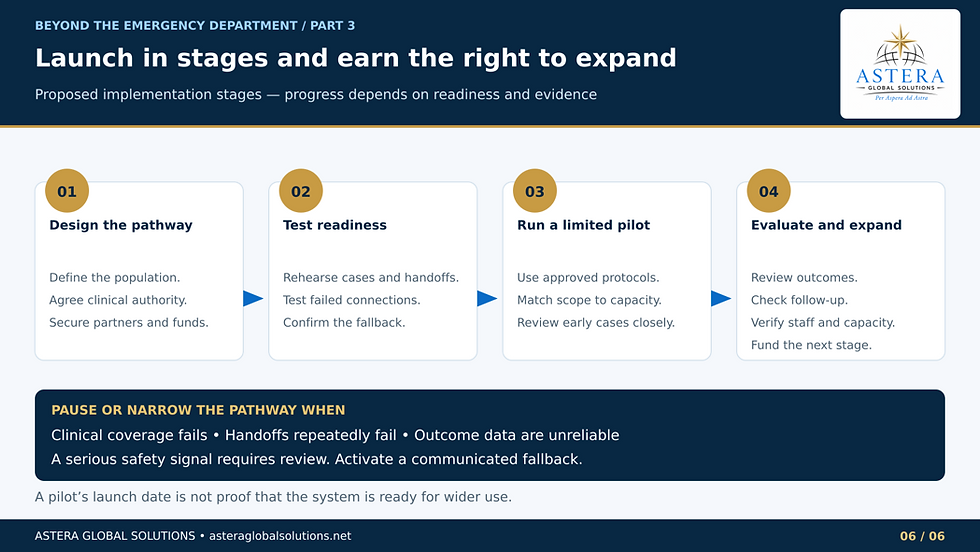
Launch in stages and earn the right to expand
I would organize implementation around four stages, with a review before moving forward. This is a proposed management approach, not a nationally mandated timetable.
First, design the pathway. Define the local problem, patient population, clinical authority, receiving partners, funding, and evaluation plan. Agree who owns every transition and what would require the pathway to pause.
Second, test readiness. Walk through the process with dispatch, field teams, remote clinicians, and receiving staff. Use simulation and retrospective case review to test decisions and handoffs before changing live care. Confirm that information reaches the correct person and that failures produce an actionable alert.
Third, run a limited pilot under the approved protocol. Limit the initial population, geography, hours, or partner network to what can be supported safely. Review early cases closely, track missed connections, and ask patients and staff where the process breaks down. Keep the usual emergency response available outside the pilot's scope.
Fourth, evaluate and expand selectively. Decide whether outcomes are sufficiently understood, follow-up is reliable, partners have capacity, and funding supports the next stage. Where feasible, use a comparable group and appropriate analytical support when estimating impact. A small pilot with no detected harm does not establish that rare harm cannot occur.
IHI's Plan-Do-Study-Act approach supports testing changes locally, learning from the results, and refining them through repeated cycles. The four stages above provide a management structure within which that testing can occur. IHI guidance on testing changes
Pause or narrow the affected pathway when essential clinical coverage disappears, handoffs repeatedly fail, outcome data become unreliable, or a serious safety signal requires investigation. A pause should activate a communicated fallback for patients and staff.
Expand when the evidence, workforce, receiving capacity, and funding support expansion.
What this looks like for one patient
Consider a hypothetical patient whose assessment meets a locally approved pathway for timely community care. The patient understands the options and agrees to the plan. A navigator confirms an appointment with a service capable of managing the identified need, arranges accessible transportation if required, and transfers the clinical information.
The patient receives clear instructions and knows whom to contact if the appointment does not occur or symptoms change. The responsible team confirms whether care was received. If the clinic cancels, a named clinician reassesses the next step. If the patient's condition warrants emergency evaluation, the pathway supports that escalation.
The useful achievement is visible at the end: the patient received appropriate care, the transition was accountable, and the organization knows what happened.
That same test applies to a home visit, a telehealth encounter, a behavioral-health referral, or an alternative destination. Each pathway needs a clinically appropriate entry point and a dependable next step.
Complete the system around the patient
Across this series, the central issue has been the gap between the help patients seek and the options available when they seek it. EMS is often the service that encounters that gap directly.
Community paramedicine, nurse navigation, telehealth, and alternative destinations can help organizations respond more appropriately. Their value depends on the clinical support, receiving capacity, communication, and funding behind them.
For leaders, the work begins with a concrete commitment: identify a care gap, build an accountable pathway, and evaluate what happens to the people who use it. Retain what works, repair what fails, and make emergency escalation straightforward.
The patient who calls for help should leave the encounter with a workable plan and a service prepared to carry it through.
Start the conversation
Which step in your community's care pathway is most likely to fail today: timely assessment, access to an accepting service, transportation, follow-up, or sustainable funding?
Bring that question to your next meeting with EMS, primary care, hospital, community-service, and payer partners. Choose one patient group and trace its journey through to completed care.
Astera Global Solutions works with EMS and healthcare organizations in the United States and internationally on clinical quality, education, operational performance, and system development. If your organization is exploring community paramedicine, nurse navigation, telehealth, or alternative destinations, contact us to discuss your current pathway and implementation priorities.
Visit Astera Global Solutions or email info@asteraglobalsolutions.net to start the conversation. Share this article with a colleague responsible for the next step in your patients' care, and tell us where your community most needs a better connection.
References
Centers for Medicare & Medicaid Services. (2025). Emergency Triage, Treat, and Transport model: Final evaluation report.
Centers for Medicare & Medicaid Services. (n.d.). Emergency Triage, Treat, and Transport model: Frequently asked questions.
Institute for Healthcare Improvement. (n.d.). Model for Improvement: Establishing measures.
Institute for Healthcare Improvement. (n.d.). Model for Improvement: Testing changes.
NHS England. (2025). Single point of access. Guidance originally published August 28, 2024; updated May 7, 2025.
Ulintz, A. J., O'Connor, L. C., Heffern, T. M., Rowe, J., Rollman, J. E., Wingrove, G., Zavadsky, M., Wilcox, M. R., & Goldberg, S. A. (2026). Mobile integrated health care and community paramedicine: A position statement and resource document of NAEMSP. Prehospital Emergency Care, 30(6), 739–751. Published online August 21, 2025.


Comments