Tiered EMS Systems Part 2
Designing the Response
The second article in a three-part series on matching EMS response capabilities with patient needs.

The crew has assessed the patient. A community service may be able to provide the next stage of care. The referral number is correct, but nobody answers.
Who remains responsible for the patient? How long should the crew continue trying? What happens if the patient's condition changes?
Those questions belong in the operating plan before the first referral is made.
Part 1 of this series distinguished response priority, clinical capability, and service function. It examined how different countries and regions coordinate dispatchers, rescuers, EMTs, paramedics, nurses, physicians, and specialist practitioners.
Part 2 moves from describing those arrangements to designing how they work. A useful tiered system needs clear decisions about the initial response, clinical consultation, additional resources, transport, and transfer of responsibility. It must also work when the preferred option is unavailable.
This connects directly with our Beyond the Emergency Department series. Community paramedicine, nurse navigation, telehealth, and alternative destinations become more useful when the response system can identify an appropriate patient, arrange the necessary care, and complete the handoff.
The design recommendations below are a framework for local discussion. Clinical eligibility, professional authority, and response rules must be established through the relevant medical oversight and regulatory processes.
Begin with the patient journey
Before deciding how many response tiers to create, examine what happens to patients through the existing service.
Review representative encounters across different locations and times of day. Include time-critical emergencies, patients whose condition changed after the call, people who needed transport without advanced treatment, and patients who could have benefited from an available community service.
Follow each encounter from the initial call to the next stage of care. Identify where information was lost, where staff waited for a decision, and where a proposed service could not accept the patient. Involve dispatch, field clinicians, medical leadership, nursing, operations, and receiving services in that review.
A delay in getting advanced clinical capability to a patient calls for a different response from a delay caused by an unanswered referral line. Buying another specialist vehicle will not necessarily solve the second problem.
The result should be a description of the functions the community needs and the gaps that currently prevent them from working. Fleet configuration and staffing should follow that analysis.
Give dispatch a way to revise the response
Initial telephone triage organizes an immediate response using the information available from the caller. It cannot provide all the information that may emerge through further questioning, examination, or reassessment.
Singapore's Civil Defence Force describes its tiered framework in terms of telephone medical triage and matching the scale and speed of response to severity. Its Operations Centre specialists receive support from paramedics and Ministry of Health nurses. This illustrates how clinical support can be connected to the first response decision. [1]
Local protocols should specify when resources must be sent immediately, which calls may enter further clinical assessment, and how a change in the reported condition alters the response. Urgent dispatch and additional information gathering may need to occur at the same time. Patients should not have to progress through every tier before receiving necessary help.
Secondary clinical triage serves a different purpose from the initial prioritization step. An appropriately prepared clinician undertakes a more detailed assessment and may identify a suitable alternative service, provide advice within their authority, or determine that an ambulance response is needed.
Ambulance Victoria describes nurses and paramedics working together in this role. Its account of a triage practitioner's work includes both arranging an emergency ambulance response and referring suitable patients to services such as the Victorian Virtual Emergency Department or a home nursing visit. Secondary assessment can therefore move a patient toward emergency resources as well as toward another pathway. [2]
Research also cautions against assuming that a call entering secondary triage will end without transport. A 2020 retrospective study examined patients aged 65 and older in metropolitan Melbourne within five common paramedic diagnosis groups, using data from September 2009 to June 2012. Patients receiving an ambulance after secondary triage had similar hospital transport rates to those dispatched directly, although they were less likely to receive paramedic treatment. The authors suggested that some might have been suitable for other transport or referral options. The study did not prove that those alternatives would have been safe for every patient. [3]
My operational takeaway is to assess the appropriateness of the eventual decision. Sending an ambulance after further assessment may be the correct outcome. A target that treats every return to ambulance dispatch as failure could discourage necessary escalation.
The operating plan should also specify who monitors patients waiting for a callback, what prompts repeat contact, and what happens when staff cannot complete the assessment. Interpreter access, communication disabilities, unreliable connectivity, and callers who are not with the patient all deserve attention in pathway design.
Reassessment must be able to change the plan.

Define the work before assigning professional titles
An effective staffing discussion starts with the decisions and care that a role must deliver.
In the United States, the National EMS Scope of Practice Model distinguishes education, certification, licensure, and credentialing. The model supports state systems; it does not itself authorize practice. Adding a new assignment to a paramedic's schedule does not establish that the clinician has the preparation or permission needed for that assignment. [4]
The same care is needed when discussing international models. A nurse undertaking telephone assessment, a paramedic providing critical care, and a physician coordinating emergency response contribute different capabilities. Titles alone cannot establish whether they can undertake the same tasks.
For each proposed function, document the following:
Function | What the service must define |
Initial response and stabilization | Required clinical capability, equipment, immediate actions, and criteria for additional help. |
Further assessment and care planning | Who can make the disposition decision, what information they need, and when consultation or examination is required. |
Specialist support | The problem the specialist is intended to address, how to request support, and what happens while support is pending. |
Transport and transfer | The patient's care and mobility needs during travel, the appropriate crew and vehicle, and the receiving handoff. |
Ongoing community care | The accepting service, arrangements for follow-up, and responsibility for responding to deterioration or a failed plan. |
These functions may be combined in one team or distributed among several services. The table is a planning tool, not a new licensing hierarchy.
London Ambulance Service provides an example of linking specialist practice with deployment. Its Advanced Paramedic Practitioners in Critical Care work both in response cars and in the control room, where they help identify cases requiring that capability. Its Urgent Care practitioners provide advice and remote support to colleagues as well as assessment in the field. Their roles connect specialist expertise with decisions about where that expertise is needed. [5]
Lombardy's AREU describes a different arrangement: basic crews, nurse-based advanced response, and advanced crews with a physician and nurse. It also describes communication with the operations room through clinical information, telephone calls, and, in specified circumstances, transmitted ECGs or video. The relevant lesson is the relationship between field capability and coordination. These regional arrangements do not establish equivalent professional roles across Italy or other countries. [6]
For a new role, I would also specify supervision, orientation, competency assessment, continuing education, and access to case feedback. A responder needs to know both the expected work and the point at which another professional or service should become involved.

Plan staffing and deployment around actual availability
A tiered model needs to account for simultaneous calls, travel distances, transport demand, and periods when a specialist team is already committed.
Response capability and transport capability are separate planning questions. A clinician in a response car may bring valuable expertise but cannot substitute for the vehicle and crew required to move a patient safely. A transport vehicle may be available while the clinical capability needed for the journey is not.
Seattle and King County describe dispatch assessment, BLS first response, ALS care for more critical situations, and transport through different agencies according to need. The example illustrates how responding, treating, and transporting can be coordinated across resources. It should not be taken as proof that the same deployment pattern will suit every community. [7]
Local planning should examine when specialist requests occur, how long teams remain committed, what happens during transport, and whether a response leaves another area without practical cover. Average demand alone will not describe the pressure created by overlapping calls.
Rural services may need broader capability on routinely available units because additional help is distant. A metropolitan service may be able to share specialist resources across several response areas. Each proposal needs to be tested against its geography and available workforce.
Remote consultation can support a clinician already with the patient. It cannot provide the hands, equipment, or transport that must be physically present. Similarly, a community referral option that operates only during the day needs a defined out-of-hours alternative.
Build the deployment plan around the roster that can actually be staffed, including breaks, leave, education, and surge demand. A resource listed on an organization chart is not necessarily available for the next patient.
Every specialist function needs a documented plan for when that resource is unavailable.

Put medical oversight into everyday decisions
Medical oversight should define how clinicians obtain advice, who may authorize a change in the care plan, and how urgent concerns are escalated. A protocol document cannot answer a consultation request on its own.
At the system level, I would distinguish responsibility for approving the service model from responsibility for individual clinical decisions. Operational leaders also need a defined role in securing resources and managing capacity without informally changing clinical eligibility.
The frontline process should identify the primary contact, the backup contact, what information to communicate, and what action is required if advice cannot be obtained within the timeframe appropriate to the patient's condition. Requesting clinical advice should not delay an emergency response already indicated under local protocols.
NHS England's March 2026 urgent community care framework emphasizes clarity about clinical responsibility after assessment, during handover, and throughout treatment. It also addresses shared decisions, support at home, senior clinical input, and escalation arrangements. The document explicitly supports clinical decision-making rather than serving as clinical policy. It is useful for thinking about interfaces between organizations; it is not authorization to apply an English pathway in another jurisdiction. [8]
Staff should be able to report that a pathway did not fit the patient or that an intended service was unavailable. Review should examine the circumstances and the decision, including whether the system provided the support the clinician needed.
Make alternative destinations available in practice
Our earlier series examined alternatives to the emergency department. Tiered response can support those pathways by bringing the appropriate assessment and coordination capability to the encounter. The receiving service still has to be able to deliver the care.
For each pathway, agree on the eligible population, decision authority, operating hours, referral contact, acceptance process, transport arrangements, and response to deterioration. Give crews a reliable way to determine whether the service is currently available.
Include patient preferences, decision-making capacity, language needs, accessibility, and support at home in the assessment. Consent and refusal processes must follow local requirements. An alternative should be explained as a clinical option, with its limitations and next steps, rather than presented as an obligation to reduce ED use.
The distinction between offering a referral and accepting responsibility is operationally important. NHS England's published ambulance-to-urgent-community-response examples include digital systems in which providers accept or reject cases. Some examples return declined or unanswered referrals to the ambulance incident queue while preserving the original queue position. Those are documented local arrangements, not a universal rule or waiting-time recommendation. [9]
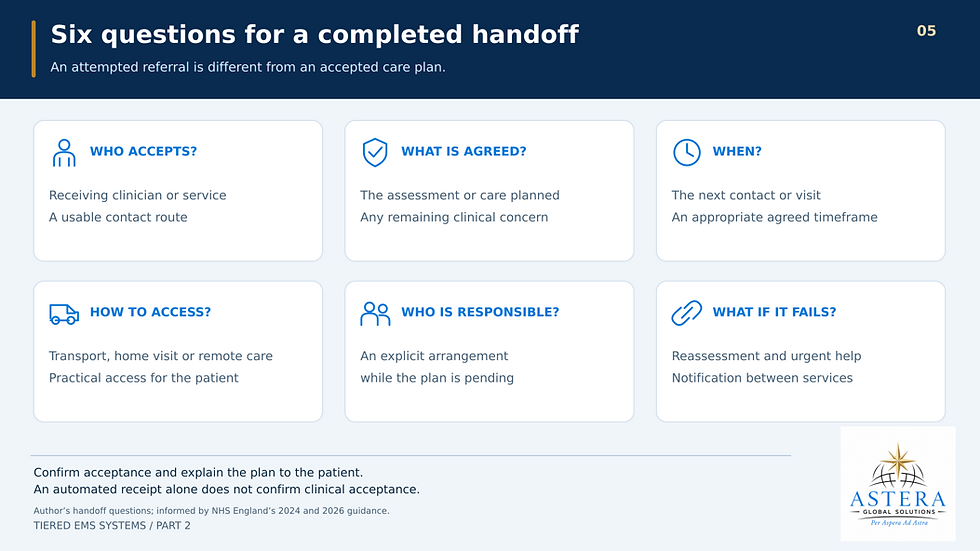
For a proposed local pathway, I would require staff to be able to answer six practical questions before regarding the transfer as complete:
Handoff question | Information to establish |
Who is accepting the patient? | The receiving clinician or service and a usable contact route. |
What has been agreed? | The assessment or care to be provided and any remaining concern. |
When will the next contact occur? | An agreed timeframe appropriate to the patient's needs. |
How will the patient reach the service? | Suitable transport, a home visit, or an accessible remote appointment. |
Who is responsible while the plan is pending? | An explicitly agreed arrangement for the interval before care begins. |
What happens if the plan fails? | A route for reassessment, urgent help, and notification between services. |
The exact transfer point and documentation should be agreed by the participating organizations. Sending a message, receiving an automated receipt, and obtaining clinical acceptance are different events.
Ambulance Victoria's 2024-25 annual report describes its clinicians connecting patients with the Victorian Virtual Emergency Department, where emergency doctors can assess patients remotely and arrange further care. It also describes expanded specialist services and follow-up calls. This illustrates the value of connecting triage to a functioning service beyond the initial EMS contact. The service description alone does not prove a causal improvement in outcomes. [10]
The patient needs to understand the plan and how to obtain help if circumstances change. Staff need a way to confirm whether the promised next contact occurred.
Follow one encounter through the whole system
Consider a hypothetical adult calling for help after a change in their ability to manage at home. This is a planning example, not a clinical eligibility rule.
The initial assessment determines the response required under local protocols. If the information indicates an emergency, the necessary resources are sent. If the call is suitable for secondary assessment, that assessment may still lead to an ambulance response. A community option is not assumed from the caller's description alone.
Where a field response occurs, the attending clinician assesses the patient and seeks additional advice or resources when needed. Suppose an authorized clinician determines that a community service could meet the patient's needs. The patient agrees, the service accepts the referral, and the teams establish the timing, transport or home-visit arrangements, interim responsibility, and escalation plan.
Now change one condition: the service cannot accept the patient. The response should return to an active decision about the next appropriate option. Staff should not record a successful alternative pathway simply because a referral was attempted.
Change another condition: the patient deteriorates while arrangements are being made. The response and destination decision must be reassessed. Any urgent escalation takes priority over completing the original referral.
The pathway succeeds when it adapts to the patient's needs and produces an appropriate next step, including emergency care when indicated.
Rehearse the points where the plan can fail
Before implementation, use tabletop exercises and simulation to test the handoffs between services. Involve the people who will answer the calls and make the decisions, including staff working outside normal office hours.
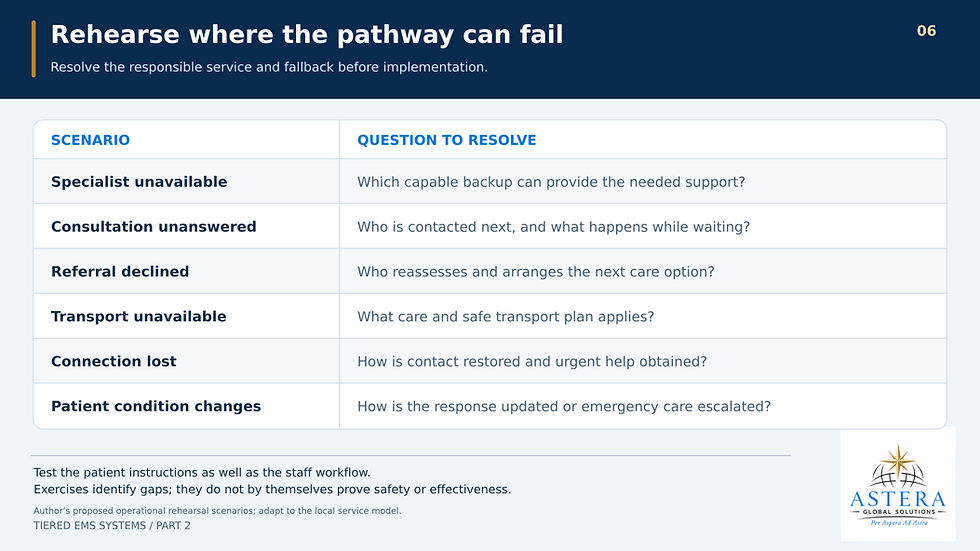
Test an unanswered consultation request, a specialist unit already committed elsewhere, an unavailable transport crew, a declined referral, loss of connectivity, and a change in the patient's condition. Establish who notices the problem and who must act.
For each exercise, record the decision, the responsible person or service, the communication route, and the event that would trigger escalation. Identify any step that depends on an informal personal contact or on the patient solving an access problem alone.
Review patient information as well as staff instructions. Explain why a different professional or service may respond, what that service can provide, and how reassessment or emergency help can be obtained. People should not have to understand the organization chart to receive care.
These exercises cannot prove that a model is safe or effective. They can reveal unresolved responsibilities and missing resources before those weaknesses affect a real encounter.
What comes next
Part 3 will examine implementation and accountability: workforce preparation, funding, phased testing, patient safeguards, data quality, and evaluation. It will consider what evidence should support expansion, revision, or suspension of a pathway.
For now, the design test is practical. Can the people delivering the service explain who responds, who decides, who accepts the patient, and what happens when the plan needs to change?
Start the conversation
Which handoff in your EMS system is most likely to fail after hours: clinical consultation, access to transport, receiving-service acceptance, or follow-up?
Choose one and review it with the teams on both sides of the transfer. Bring an actual process, identify the unresolved responsibility, and agree on the next improvement to test.
Astera Global Solutions is based in the United States and works with EMS and healthcare organizations internationally on clinical quality, education, operational performance, and system development. If your organization is considering tiered response or connecting EMS with alternative care pathways, contact us to discuss how the model could fit your community and workforce.
Visit asteraglobalsolutions.net or email info@asteraglobalsolutions.net. Share this article with a colleague involved in dispatch, clinical leadership, operations, or community care, and tell us which connection your system needs to strengthen.
References
Sources checked September 28, 2026. Service examples describe their cited jurisdictions; proposed design tools should be adapted locally.
1. Singapore Civil Defence Force. (n.d.). Emergency Medical Services.
2. Ambulance Victoria. (2025, May 12). Thank you to AV’s nurses.
3. Eastwood, K., Nambiar, D., Dwyer, R., Lowthian, J. A., Cameron, P., and Smith, K. (2020). Ambulance dispatch of older patients following primary and secondary telephone triage in metropolitan Melbourne, Australia: A retrospective cohort study. BMJ Open, 10(11), e042351.
4. National Association of State EMS Officials. (2019). National EMS Scope of Practice Model 2019. National Highway Traffic Safety Administration.
5. London Ambulance Service NHS Trust. (n.d.). Advanced Paramedic Practitioners.
6. Agenzia Regionale Emergenza Urgenza. (n.d.). FAQ 118.
7. Public Health Seattle and King County. (n.d.). About the Emergency Medical Services system.
8. NHS England. (2026, March). Urgent community care: Clinical decision-making framework.
9. NHS England. (2024). UCR and Ambulance Referral Blueprint: Examples of 999 and Urgent Community Response pathways.
10. Ambulance Victoria. (2025). Right care, right patient, right time. Annual Report 2024–25


Comments